You are here: Home Articles Aliens For Their Faith

Aliens For Their Faith

E-mail Print
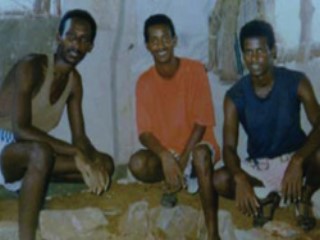
 From left to right: Paulos Eyassy, Isaac Mogos, and Negede Teklemariam, imprisoned since September 24, 1994, for their conscientious objection to serving in the Eritrean militaryEritrea: Putting A New Face On Religious Intolerance

There is much religious intolerance in this new, twenty-first century. This is the tale of religious intolerance in an obscure country in East Africa called Eritrea. After fighting for its own freedom from Ethiopia for more than 30 years, this Marxist regime has forced a peace-loving community of Christians to become little more than aliens in their own land.

While known the world over as a group of devoted preachers, Jehovah’s Witnesses in Eritrea have been the target of a brutal and protracted government-sponsored campaign of terror. All Witnesses have been stripped of their citizenship and the rights that go with it, apparently with the intent of breaking their faith or of wiping them out as a presence in that country.

While Jehovah’s Witnesses are not the only faith under attack in Eritrea, independent human rights observers say the persecution of this group is particularly intense, extending over the better part of two decades. “Muslims and especially Jehovah’s Witnesses have suffered persecution as a consequence of their refusal to take part in compulsory military service. Persecution of Jehovah’s Witnesses is particularly pronounced given their refusal to vote in the independence referendum,” says the 2008 edition of the book Religious Freedom in the World, edited by Paul Marshall and published by the Hudson Institute, a Washington think tank that reports on human rights violations around the globe.

“The government views not participating in military service as a threat to the state,” says Alan Gallina, a human rights specialist with the Jehovah’s Witnesses, who are headquartered in Brooklyn, New York, and have more than 7 million members in 235 lands across the world. “But if that’s the case, why are there 2- and 3-year-olds in prison right now? Why are there 75-year-olds in prison? How can they be a threat?”

A country of about 5 million people on what’s known as the Horn of Africa, Eritrea shares borders with Sudan to the west, Ethiopia to the south, Djibouti to the southeast, and the Red Sea to the east. As of September 2009, 60 Eritrean Jehovah’s Witnesses were known to be imprisoned for reasons ranging from conscientious objection to military service, to participation in religious activity such as preaching, to meeting in a Bible study group. More than half of the arrests have had nothing to do with participation in military service. Three of the prisoners have been held since September 1994, spending the better part of their lives in prison.

On June 28, 2009, 23 members of one congregation of Jehovah’s Witnesses in the capital of Asmara were peacefully meeting together for Bible study in a private home when Eritrean authorities raided the meeting and imprisoned Witnesses and interested persons alike. Three children ranging in ages from 2 to 4 years were among the group, which also included a child of 8, a woman over 70, and another over 80. The majority of these arrests were of women, since the government had long since arrested their husbands and sons. Most remain in prison today. This is the latest in a pattern of persecution extending back to 1994.

“There is a misunderstanding about who we are,” says Philip Brumley, general counsel for Jehovah’s Witnesses, in an interview from his office in Patterson, New York. “If the government would understand who we are, we are confident that this mistreatment will end.”

Yet, governmental officials have rebuffed most efforts by the religious group to foster any understanding beyond what’s already known by them. And the little that the government knows, they don’t like.

Jehovah’s Witnesses began showing up on the government’s radar in April 1993, when more than a million Eritreans voted for independence from Ethiopia in a U.N.-supervised referendum. That vote was the culmination of a battle between the two countries spanning some three decades and led by a man who would become president of the newly formed government. The referendum marked the embryonic stages of severe and protracted persecution of Jehovah’s Witnesses—who, for conscientious reasons, elected not to participate in the referendum.

Their reasons for not voting are rooted in their stand of strict neutrality in political and governmental issues. This has been a tenet of the Jehovah’s Witnesses’ faith for nearly 100 years, bringing them in harmony, they say, with both Jesus’ teachings and the model set forth by the first-century Christian congregation. They cite the words of Jesus Christ to Pontius Pilate as recorded in John 18:36: “My kingdom is not of this world. If My kingdom were of this world, then My servants would be fighting so that I would not be handed over to the Jews; but as it is, My kingdom is not of this realm.”* Like Jesus, they obey the governmental authorities when the laws promulgated do not interfere with their obligations as set forth in the Bible.

This has put them at odds with Eritrean officials, who seem to believe the state is sovereign in people’s lives—even over God. Jonah Fisher, a former BBC correspondent based in Asmara, writes that the repression of religion is a result of the government being “afraid that people who consider their highest allegiance to be God, at some point may not be patriotic and follow the state’s instructions,” according to his September 17, 2004, report published by the BBC.

If the Witnesses’ nonparticipation in the referendum put them on the government’s radar, however, their firm stand against military service landed them right in the government’s crosshairs as its main target against conscientious objectors.

After 30 years of war it was no surprise that Eritrea’s new leaders maintained a war mentality. Once Eritrea achieved independence, it became what Paul Marshall of the Hudson Institute calls a “militarily mobilized national security state.” This militarized state seemed bent on making an example of Jehovah’s Witnesses for their conscientious objection to military service.

But the stand taken in Eritrea is not new for Jehovah’s Witnesses, who have steadfastly refused to serve in any military organization of any nation. Their stand is well known in the United States and Europe, where they have exercised their conscientious objection even in the face of death at the hands of totalitarian regimes such as the Nazis during World War II.

“We are not subversive; we are not anti-Eritrean,” says Brumley. “History confirms that Jehovah’s Witnesses will not perform military service. This is not a country-specific position. It is a trait of Jehovah’s Witnesses.” He adds, “Just the fact that Jesus said the world would recognize us by the love we show among ourselves, it is inconceivable that Witnesses would allow themselves to be divided by national barriers.” The scriptural basis for this teaching of Jehovah’s Witnesses is found in John 13:35, where Jesus said the identifying characteristic of His followers would be their collective “love for one another.”

Notwithstanding the Jehovah’s Witnesses’ long-established stand, Eritrean officials were intent on establishing their own legacy. On September 24, 1994, three young Jehovah’s Witness men were imprisoned, ostensibly for their refusal to join the military. Paulos Eyassu, Negede Teklemariam, and Isaac Mogos have been imprisoned for the past 15 years—isolated from families and community—despite the fact that the maximum penalty for conscientious objection under Eritrean law is three years.

“The families were deeply grieved at first. Every day since then, worry is added to their grief,” said friends of the family in a report published by Jehovah’s Witnesses on the tenth anniversary of their imprisonment. “They are afraid to speak about it or share what little they do know, for fear of adverse consequences on the men in prison.”

One month after the arrests—almost to the day—the government took an even stronger stand. On October 25, 1994, Eritrean president Isaias Afworki issued the following presidential declaration:

“A group calling themselves ‘Jehovah’ [sic], who are Eritreans by birth, but who have revoked their Eritrean citizenship by their refusal to take part in the referendum, have now reconfirmed their position by refusing to take part in the National Service, thus deciding to revoke their citizenship.”

The immediate result of this decree was swift and decisive. All Jehovah’s Witnesses in Eritrea were stripped of their basic civil rights and barred from working in any governmental employment. Additionally, their business licenses, identity cards, and travel documents were summarily revoked, refused, and/or taken from them. The result has caused tremendous economic hardship in a country already among the poorest in the world. Worse, the decree marked the beginning of a dark period for Eritrean Jehovah’s Witnesses, whose families have been torn apart and disenfranchised by the merciless persecution and imprisonment of children as young as 2 and men as old as 90.

The first communities of Jehovah’s Witnesses in Eritrea date back to the 1940s. But since 1995, at least 250 Jehovah’s Witness families have fled Eritrea and sought asylum outside the country because of the hardships. More than 100 Witnesses lost their employment because of their religion, affecting their immediate family and others who relied on their support. At least 38 Jehovah’s Witnesses were denied business licenses and 37 families have been expelled from their homes, with little prospects for renting a home because of the climate of hate and discrimination.

“The detention of individuals solely because of their religious beliefs is part of the general denial of the rights to freedom of expression and association in Eritrea, as well as other grave violations of basic human rights,” states a December 2005 report by Amnesty International on religious persecution in Eritrea. “These violations of the right to freedom of thought, conscience and religion are contrary to international law, as well as the Constitution of Eritrea.”

The violations go well beyond economic hardship and community ostracism, however. According to the bookReligious Freedom in the World, there are few places on earth where religious discrimination is so egregious and human rights are so often ignored. By all accounts, Eritrean incarceration can be compared only to concentration camps. Marshall writes: “With grueling work and little food, prisoners are often placed in overcrowded makeshift corrugated tin housing, which exacerbates both the intense heat of the day and the cold of the night. In such an environment, disease spreads quickly, and medical facilities are often either lacking or deliberately withheld. Frequent reports have emerged of confinement in underground cells or metal shipping containers, both of which serve as especially severe punishment.” “Life in detention centers is extremely harsh since it occurs in some of the hottest places on earth. . . . In such conditions, people have died or gone insane.”In the 2004 BBC report by Fisher, Fisher quotes a journalist who had seen firsthand the human rights violations in Eritrea. “All of these things are just happening repeatedly over and over from people of all different Christian denominations and the Jehovah’s Witnesses,” wrote Fisher, quoting the reporter. “I’ve seen the scars on people’s legs, I’ve seen their tears and it’s very real and they live under a lot of fear.”

It goes without saying that these government-sanctioned actions violate the Universal Declaration of Human Rights and the pledge Eritrea made when it joined the United Nations. Incredibly, Eritrea is violating its own constitution, which was ratified in 1997 but never enacted. Article 19 of the document provides for freedom of conscience, religion, movement, assembly, organization, and expression of opinion. “In reality, however, the government quashes any freedoms perceived to diminish national security or unity,” writes Marshall.

Against this flood of persecution, Jehovah’s Witnesses in Eritrea are not giving in or giving up. “I interviewed a few young brothers and sisters and, by and large . . . . their faith is intact and they are strong,” says Gallina. “In fact, their faith has been made stronger.”

Gallina says that the Witnesses are still attempting to send a delegation to meet with President Afworki or his key people. “We almost always find that meeting with officials helps mitigate problems,” he said, adding that any efforts made toward resolving these issues are done “rather cautiously because we are concerned how this will affect our brothers and sisters.”

One of the potential remedies available to both sides is the adoption of a system of civilian national service under the oversight of a nonmilitary branch of government. Such a system of alternative service is made available to Jehovah’s Witnesses and other conscientious objectors in countries such as Cuba, Denmark, Germany, Colombia, Taiwan, among others, according to Brumley.

“Generally speaking, most Jehovah’s Witnesses do not object to performing national service,” said Brumley. “Of course, it cannot be under military supervision, and whether or not one accepts to perform such service is up to the individual’s conscience.” He adds, “If the government needs help to build schools, improve roads, and if there was national service that is civilian, very likely many young Witnesses would be there to help out. . . . Right now, however, they are taking young men and instead of using them to build bridges or schools, they have them sitting in prison.”

Witness officials stress that patience is a must, even after years of severe treatment. “In spite of the chronic mistreatment of Jehovah’s Witnesses, we are nevertheless hopeful that through dialogue these misunderstandings can be resolved and peace established,” says Brumley. “In spite of the way we have been treated, we still want to sit down and talk with the government so that the persecution will end.”

It has been said that Eritrean parents will quote an old Eritrean proverb to their children: Kwakolo kus bekus bougru yehahid, which means when translated, “Little by little an egg will walk.” This refers to the process by which an egg is hatched, a chick emerges, and it gradually grows into an adult, teaching a child to reach a goal by working at it day by day. Jehovah’s Witnesses are hoping this proverb holds true in their dealings with the Eritrean government—that little by little, day by day, their efforts will one day help deliver their fellow worshippers from this crucible of persecution.

Robert J. Hendriks III is a freelance writer from Long Island, New York, with some 25 years’ experience in both print and television media. He has been a minister of Jehovah’s Witnesses for the past 30 years.


Comments  

 
-7 #30 Nimen 2010-07-25 07:50
Debra,

U r just bluffing whatever comes to ur mouth.So just do us a favor, shut up and worry about ur people.Africa is not any more a ''white man's burden''.

For the writer,

In Every country, there are duties a citizen have to do to claim certain rights.And these people we r talking about refused to do their duty, and they r denied their rights.As simple as that!
 
 
+7 #29 Lucy 2010-07-23 02:57
Thank you for posting this article...Robert J. Hendriks III...
let everyone have the opportunity to practice what they believe...no one has the right to force anyone... and if Eritrean government doesn't recognize the Jehovah's Witness as Eritrean citizens why are they taking them to prison? Leave them along and live their life peacefully and let the kids be kids not prisoners...what kind of sick and twisted government is that?
Lucy from Canada
 
 
-5 #28 Nasrawi 2010-07-21 23:02
yg

Shaebiawinet/Eritrawinet

you are a total sham when you try to coin a label.
Let us see your new nomenclature shaebianism
"...it has its own version and not nationalism...."
If you had been following the national struggle
it was a historic development of the struggle
that history doubled and wholly put its responsibility
on EPLF/shaebia after 1981/82.
so it didn't have any alternative than to shoulder it.
And it was only EPLF in the field which every eritrean was
looking for to bring our sewra to its declared goals though
we have other issues we were all in one in this case
SO ERITREANISM AND "SHAEBIANISM" AS YOU PREFER TO CALL IT NOW CAME TO CONVERGE AS ONE.
so it was not a choice but a responsibility burdened by history
and you should not blame any eritrean for this.
 
 
+11 #27 sara ,Italy 2010-07-21 22:32
Need help, please
Can you be an opposition
without hating ERITREA ?
sara, ITALY
 
 
+1 #26 Hagherawi 2010-07-21 21:31
yg,

The "the ghedli atrocities" you talk about very often to make sensations, was not about civilians being killed, it was about 'tegadelti'. Although it's a waste of time, to argue about historical crimes of gedli with someone who want prove to us that Ethiopia is better, it is a well known fact that the purges were not about Christians or Muslims being killed on religious ground. It was rather power struggle in the name of ideology. There were more cases of Christians being killed by Christians and Muslims being killed by Muslims, for reasons that have nothing to do with religion.
The persecution of civilians is a different story.
Get the facts before writing sensational stories with little substance.
 
 
-10 #25 Senayit88 2010-07-21 21:00
#19 yg
Are you saying that ELF was targeting Eritrean Christians because they were crusaders ? For sure PFDJ was targeting Eritrean muslims post independent just because they were against asking for their right and dignity labeling them Jihadist. For sure the Christians were in support of PFDJ when kidnapping and killing the Muslims. They used to claim that Nsu won't arrest them if they haven't done some thing wrong. Now the table is turn 180 degree and people are screaming loud.

Your analysis is full of hot air with no substance and reflection based on experience.
 
 
-5 #24 ben Ezra 2010-07-21 17:34
yg
your spins and twists ....but for a reason
(introduction for next post )
Now to your evading
"You said when you ask them.....why sacrifice....."
declaring yourself outsider with do not know why people are dying and what for.....
you seem you asked kids or 7 or 8 graders or some kids
who are born growing away from their country or some
who didn't mature to express their points well though they
know it inside
Because I know that for sure if you ask any eritrean above
the age of 26 -30 He wouldnot tell you HE IS DYING FOR
THE SAKE OF DYING OR MARTRYDOM
so you chose your info gathered from kindergarten kids
and used it to suit your delusion and bombard unsuspecting
students and citizens of their struggle to create self doubt
to suit you delusion again.
 
 
-10 #23 eye witness 2010-07-21 17:10
the seven jehovas of
1992-93
It is not the fact that they are belivers of some kind
of belief .Nobody cared about it , it was that they were
deliberately timing political campaigning and fight
deliberately to counter and be at odds to what the
people were aspiring and the government was doing
and intentinally timing it at the time of celebrations
and festivities.
This is after they failed to attract the attention they needed and after several
pre-empts and provacations which were running counter
to what the people were preparing to put their 30 year of suffering and struggle to a close...
 
 
+7 #22 Debra 2010-07-21 11:37
LET THESE PRISONERS GO!!!

LET THEM BE SPONSORED TO ANOTHER COUNTRY!!!


Debra, Australia
 
 
+10 #21 Debra 2010-07-21 11:35
They have stopped Eritrean people from having an education & from working & being an asset to their country.

NO child should be forced into being a child soldier just so they can receive an education!

This Dictatorship & Military Regime has not benefited Eritrea. There will be no financial security for Eritrea because the government is causing the younger generation to flee the country. I believe that their murderous ways will be exposed internationally . The do not allow the UNHCR to have access to these prisoners. They can not keep hiding these Christians in the prisons until the day they die!
They currently arrest young & old men, women & children but they can not lock the whole world in prison!
n good faith they should pardon their prisoners & let them go
If it was you or your family in prison would YOU want to live your life in a 3rd world prison in ERITREA?
 
 
+11 #20 Debra 2010-07-21 11:34
Thank you for sharing these truths with the rest of the world. Eritrea does imprison Christians,Jeho vah's Witnesses & TORTURE & PERSECUTE them. They cage them in metal shipping containers in the desert & hide them underground. They sometimes allow them to go to the toilet once per day in the bush & force them to eat their excrement. They tie them up in a 8 position with their hands & legs behind their back in the heat of the desert. Many DIE from Dehydration & lack of medication for illnesses like Diabetes.
 
 
+4 #19 yg 2010-07-21 10:03
Hagherawi,

I thought we were talking about events that took place after independence. But if we are to talk about atrocities committed in mieda, why stop where you have stopped in the 80’s; why not go all the way to the Jebha of 60’s, or won’t that fit with the story you want to yarn..

And if we are to talk about the ghedli atrocities, the same realty as I pointed out in my previous comment holds true: If the Christians were reluctant to stand up for the thousands of their own who perished under the hands of both Jebha and Shaebia, how do you expect them to stand up for the religious Muslims in Sudan that you are telling us perished under the hands of Shaebia? And more importantly, if the Muslims didn’t stand up for their own kind, why do you expect that task to be done by Christians?

Again the facts are crystal clear: None of the population groups dare challenge Shaebia, be it on the grievances they have regarding their own kind or others. Period. It is as simple as that. But you, and the likes of you in awate.com, want to hedge this fact in a way that makes the Christians come out as the only guilty party.

Look at what you are saying about the websites: “As long as the elites are allergic to hearing about Muslim persecution, while publicity for Christian persecution fills the pages of our websites, the "us vs them" is a fact that reflects the reality of our times.” Oh, ya? I guess you have never visited awate.com. We have been listening to the Muslim elites’ “we are the only persecuted ones” whining ad nausea. And that, Hagherawi, is not “filling up the website pages” but overflowing ….

YG
 
 
-3 #18 Hagherawi 2010-07-21 05:02
Yosief G.

As usual you make statement that are not based on facts, this is specially true whenever you make an opinion on religious issues related to Muslims. Shabia started to kidnap religious Muslims in late eighties from Sudan, long before independence and referendum. The killing and kidnapping of 1993 was limited to people living in cities. As to why the Muslim community did not protect themselves, you are right, the response was not enough to deter Shabia to stop the killing and kidnapping. As long as the elites are allergic to hearing about Muslim persecution, while publicity for Christian persecution fills the pages of our websites, the "us vs them" is a fact that reflects the reality of our times.
 
 
+4 #17 Yohan 2010-07-21 03:22
As mehamed Mahmood sang it "Lehulu giziew yetebkletal". When it comes to tyrants, everyone will have his/her/their time to be under the tyrant's microscopic scrutuny for thorough examination to confirm their complete unconditional submission/dedication/faith to the regime. I remember a few years back, when my Aunt who happened to be a "Kenisha" follower cheering for the rounding up campaign of the Jehova Witnesses. Just not too long after that the regime " Busted/arrested/caught red handed," quite a few Kenisha youngsters while worshiping/praying/praising in Asmera's underground make shift churches. Yes, my Aunt thinks the regime has just become, unexpectedly/ suddenly pure evil. Yes, without a doubt, everyone is safe and sound until his/her/their turn comes, but rest assured it is sooner than you think. Thanks
 
 
-6 #16 YAY 2010-07-21 03:14
Dear Robert J. Hendricks III: Issues Need Clarification
I couldn't confirm if what is reported is true with any Eritrean Jehova. The 2nd issue is refusal to serve in the military based on Biblical verses on Isiah:2:4-5. The GOE argument essentially is: What is in the Bible is a promise, not a reality (all nations are not yet ruled by Jehova Witnesses) and we need to defend our freedom, you as worldly humans need not carry guns and fight, but as freedom and peace lovers, we need you to participate in the defence of our nation in some capacity. Both sides have conflicting values. Your comments.
 
 
-7 #15 YAY 2010-07-21 02:57
Dear Robert J. Hendricks III: The Issues of Conflict Need to be Clarified More
I am not a Jehova Witness, but the conflicting issues concerned me most and am interested in resolving them. What I could gather are the following: The GOE-Jehova conflict (sort of a philosophical debate) started with participation in the Referendum. Eritrean sources claim that the ER Jehova refused to recognize and abide by a worldly government directions, claiming that the sovereign is the Kingdom of God and not the Kingdom of Man. That is not about military or national sevice. GOE's response is, if you don't participate in a worldly government, we respect your right to do so, but don't expect any services from it, period. Jehovas in other nations pay taxes, vote in elections, do national service (excluding military), get employed by government, etc. contd.....
 
 
-4 #14 ben Ezra 2010-07-21 02:46
First I thank you for openly making your statements
and distanced yourself from these two points
1-the uselessness of sacrifice and
2-your acceptance of EPLF/PFDJ has never been/ is not
a marxist organization.
It is a good clarification for those who ignorantly fill up the internet pages characterizing EPLF as marxist organization
And for those who blindly write.
We have cleared one fallacy.
next.......will follow...
 
 
-8 #13 Haile-Ab Ande-Mariam 2010-07-21 01:53
Gahba,

Obviously you do not like Eritrea and Eritreans. What are you doing at Asmarino?
 
 
+10 #12 yg 2010-07-21 01:12
Ben-Ezra,

Don’t read what has not been written.

First, I have never said “the uselessness of one to sacrifice to achieve his goal.” What I have condemned is the uselessness of sacrifice for sacrifice’s sake – a defining characteristic of the culture of martyrdom.

Second, I have never claimed Shaebia was a Marxist movement. It was too nihilistic, too inarticulate to have any ideology as its driving force. In fact, I tend to agree with you in that it was somewhat nationalistic, but of its own deranged type of nationalism whose only ideology is Shaebianism itself.

In fact, we can say Shaebianism has morphed into some kind of religion. For instance, if you venture into Dehai.org, you will find to your surprise not few who profess Shaebia as their religion. Is it a surprise then if, like any other fundamentalist religions, Shaebia sees its threat coming from other religions? It wants all the youth of Eritrea to follow one religion – Shaebianism – and to worship one god – Isaias Afewerki. All its antipathy against all religions in Eritrea comes from this simple credo that every true believer holds true to his heart.

So, Ezra, do a little bit of digging (and thinking) before you start writing your halwlew.

Yg
 
 
+8 #11 Gaba 2010-07-21 00:35
PFDJ and the UNSC,
After realizing that the worldwide demonstrations it organized in February don't mean anything, the PFDJ has now 'cooled down' and is asking the UNSC to lift the sanction, citing its peace agreement with Djibout. Mind you, the regime hasn't said a word about its dealings with Djibouti. Not only that, it also hasn't communicated with UN directly, what it did is send its "offerings" thru Qatar. Call it 'atahadma Ebuyat'. What a pathatic regime we have!
 

Add comment

Security code
Refresh

Notice to all writers:

Please all English writers address your writing to articles@delina.org, all Tigrigna writers to  tigarticles@delina.org and all Arabic writers to arabic@delina.org All writings that are not addressed to these email addresses are not going to be read or posted.

Guidelines for Posting Please Click here.

Asmarino Staff

Support AI


You can also donate by sending check to:

Tesfa Delina Foundation, Inc
17326 Edwards Rd, Suite A-200
Cerritos, CA 90703

Asmarino

Graffiti Wars

Eritrea: “Our Martyrs’ Dream”

Eritrea: “Our Martyrs’ Dream”

If a book can be made to dream, the Book of Martyrdom’s wish would be to get as fat as it could possibly get: the fatter it gets, the more precious it becomes. It advices us to seek the cause in the numbers of martyrs it has meticulously compiled: the higher the corpses compiled, the greater the cause. No wonder it abhors any dietary advice from the concerned masses to keep itself lean. Its dream of getting fat was momentarily fulfilled when 20,000 more martyred during the border war were added to its already long list. But since the Book has an insatiable appetite, there is no way it could be satisfied once and for all. The perpetual deference of the ultimate goal, be it in the name of “independence”, “sovereignty”, “self reliance”, “h’adinetna” or other elusive ideals, guarantees that it never runs out of “causes” that demand further sacrifice. Thus, the sacrifice in blood and sweat in the altar of ghedli has to go on to sustain the culture of martyrdom until the whole edifice collapses out of lethal hemorrhage, which is what the latest diagnosis of Eritrea tends to indicate.

Read more...

A Reflection on the National Conference for Democratic Change

A Reflection on the National Conference for Democratic Change

Amanuel has asked the head of foreign relations of Saho why the need to form a Saho democratic movement. His answer was heart breaking:

“PFDJ is destroying our tradition and customs. During the nights our religious leaders are taken away from their residences by the security forces and are jailed. The most degrading is that they forced our people out of their traditional land and relocate them in Barka.  There was no amenities, no health care, no schools etc.  Our people demanded the right to have a say in policies that affects their lives and take care of their day to day activities and they are being severely punished for that.”

[picture: Kunama women in refugee camp in Tigray]

Read more...

Politics by Activists

Politics by Activists
A close observer will notice that there is a sneaky politics going on behind the curtains and one has the obligation to bring it to the fore of our debates.  The proponents of Ethiopian-style federal arrangement with rights to secede within EDA are trying to use organizational [i.e. EDA’s] procedures to achieve their ultimate goal of establishing a federal state with rights to secede.  EDA shouldn’t be allowed to violate its founding principles to use its ‘organizational procedures’ built on funny opposition math to advance a one-sided agenda.  The proper forum for addressing fundamental shifts in Eritrean political landscape should be left to the true stakeholders only – the Eritrean people, after a thorough debate only.  The complaint of the proponents of NCDC is that one political group, EPDP, has refused to fall for the hidden agenda.  EPDP is told that it is a minority and must abide by the modified principles of “substantial” consensus to advance other political group’s ultimate agenda. 
Read more...

‘Harmonized Constitution’: Too Good To Be True

 ‘Harmonized Constitution’: Too Good To Be True

Contrary to this, the Moslem League’s objection to the British proposal of partition is seen as a credible, pro-independence stand. Definitely, it did contribute in holding Eritrea together, but the underlying causes may have been something else. First of all, partition was understood to mean a dividing line delivering the western lowlands to Sudan and uniting the rest of the country with Ethiopia (Bevin-Sforza Plan). This would automatically deliver to Ethiopia the eastern lowlands and pockets of Islamic communities in highland areas. This would have simply been a suicide for the Moslem League. In particular the Jeberti, who recently migrated from Ethiopia claiming religious discrimination there, would not have liked to go back to a similar situation. Besides, abandoning a major part of Eritrea to Ethiopia would have been contrary to the designs of Egypt (and Sudan) who, since the Khedive, had this vicious dream of controlling Eritrea; and, depending on the influences of external forces, this motive may have created the necessary psychological setting. The other reason is that at that time the leaders of the Moslem League were confident that their final aim of establishing an Islamic state would be realized once Eritrea becomes a free nation ...
Read more...

The Eritrean Revolution and Its Child Soldiers

The Eritrean Revolution and Its Child Soldiers

The PFDJ dedicated a monument in Asmera to the bizarre plastic sandals but has understandably deprived the nation of a monument for child soldiers. But even within this bizarre world, there are no proportionately smaller sandals to be seen representing the martyred child soldiers. It is inconceivable in Eritrea‘s political landscape to tarnish the “sacrosanct” image of ghedli. Anything that attempts to do that has to be denied, proscribed and buried under for ever, and at any cost.

Ghedli, and the nation of Eritrea, has earned the reputation of mobilizing its citizenry: the teenagers, the women and the old in its long and “revered wars.” .In order to do this, a favorable climate was also present. P. W. Singer, the expert on child soldiers stated this once: the large pool of pauperized and orphaned children, the appearance of ruthless and violent political actors who feel no scruples employing child soldiers, and the rapid proliferation of small arms, and particularly the Russian automatic gun, were the enabling factors behind the rise of the new violent organizations. As a prototype, the ghedli of Eritrea neatly fits his structure.

Read more...
More:

NOTICE TO VISITORS

Due to large amount of spam, we are forced to filter all comments before they get posted. As a result, except for those who use user ID, your comment won't be instantly posted. At maximum, it might take hours before you see your comment posted.

Facebook Users can comment on Asmarino English Page on the articles as all articles are also available there.